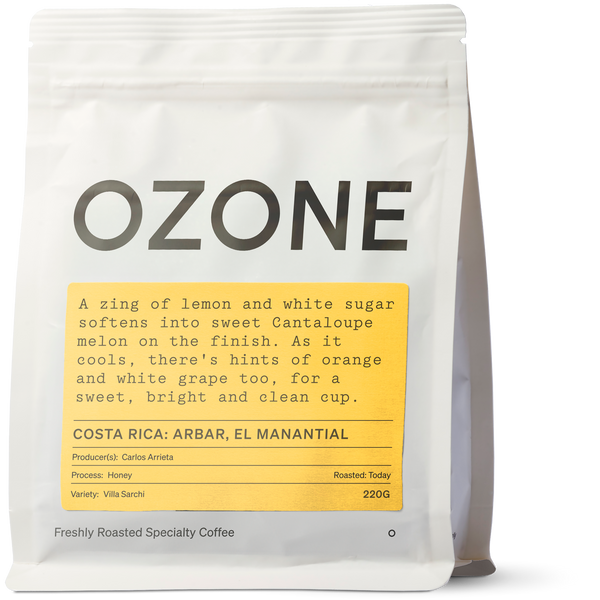
Villa Sarchi is a compact Bourbon mutation from Costa Rica with a rather impressive place in coffee history. It was discovered in the north-west of Alajuela province in the 1950s or 1960s, and its small stature made it well suited to Costa Rica's mountainous coffee farms.
It also went on to have an impact far beyond its own production. Villa Sarchi was one of the parents used to create the original Sarchimor hybrid, bringing its compact growth habit into crosses with rust-resistant Timor Hybrid material. A number of important disease-resistant varieties can trace their lineage back to that work.
Where did Villa Sarchi come from?
Villa Sarchi was discovered in north-western Alajuela, Costa Rica, in the 1950s or 1960s. It arose as a natural mutation within a Bourbon population, with a single-gene mutation responsible for its dwarf or compact growth habit.
It's closely related in that respect to Caturra from Brazil and Pacas from El Salvador. All three are naturally occurring Bourbon mutations that produce much smaller plants than typical Bourbon.
Villa Sarchi is also known by the names La Luisa and Villalobos Bourbon. After its discovery, it underwent pedigree selection in Costa Rica. Although it remains relatively uncommon outside the country, it was introduced to Honduras by IHCAFE in 1974.
The Villa Sarchi Family Tree
Villa Sarchi sits within the prestigious Bourbon lineage, which itself descends from Typica – one of the two original Arabica varietals that spread coffee cultivation around the world. Understanding where Villa Sarchi fits in this genetic family helps explain both its exceptional cup quality and its agronomic quirks.
The Villa Sarchi Family Tree
Villa Sarchi
A compact dwarf mutation of Bourbon discovered in Sarchí, Costa Rica. Known for its elegant acidity, fruit-forward sweetness, and exceptional clarity at high altitudes. Villa Sarchi became the genetic foundation for the Sarchimor group of rust-resistant hybrids.
What makes Villa Sarchi different?
The most obvious difference is its size. Villa Sarchi is a dwarf, compact plant rather than the tall growth habit associated with traditional Bourbon. That makes it easier to manage and allows growers to plant at relatively high densities.
The plant has green leaf tips and relatively small beans, both useful characteristics when distinguishing it from some other Arabica varieties. It's also particularly well adapted to high-altitude conditions and has good tolerance of strong winds, which is useful in exposed mountain growing areas.
For growers using single-stem pruning, World Coffee Research lists a planting density of around 5,000 to 6,000 plants per hectare. Villa Sarchi has medium yield potential and normally reaches first production in its third year.
What does Villa Sarchi taste like?
Villa Sarchi has a reputation for producing clean, bright coffees when it is grown in suitable conditions, particularly at higher elevations. The variety has good quality potential at altitude, and coffees from Costa Rica can show the bright acidity, sweetness and fruit character associated with it.
Flavour notes naturally vary with altitude, soil, processing and the individual coffee, so there's no single Villa Sarchi cup profile. Citrus, red fruit and floral characteristics are often used to describe well-grown examples, while washed coffees can show particularly clear acidity and sweetness.
That's worth keeping in mind when comparing Villa Sarchi with other Bourbon-derived varieties. Genetics play a role, but what ends up in the cup is always a combination of variety, environment and processing.
Growing Villa Sarchi: the trade-offs
Its compact structure and high-altitude adaptation make Villa Sarchi an attractive variety, but it doesn't have the disease resistance of many newer coffee plants.
Villa Sarchi is highly susceptible to coffee leaf rust and is also susceptible to nematodes and coffee berry disease. That makes disease management an important part of growing it, particularly in areas where rust pressure is high.
On the other hand, its tolerance of strong winds is a useful trait in exposed highland environments. World Coffee Research rates its quality potential at high altitude as good, and specifically describes it as well adapted to the highest-altitude conditions.
So Villa Sarchi isn't a variety that solves every agronomic problem. Its appeal comes from a combination of compact growth, high-altitude adaptation and good cup-quality potential, balanced against its susceptibility to major diseases.
Villa Sarchi and the Sarchimor family
Villa Sarchi's biggest contribution to coffee may have happened in a breeding programme rather than on a farm.
In 1967, breeders at the Centro de Investigação das Ferrugens do Cafeeiro (CIFC) in Portugal crossed compact Villa Sarchi with a rust-resistant Timor Hybrid plant known as CIFC 832/2. The resulting hybrid was called H361, and became the foundation of the Sarchimor group.
The reason for the cross was fairly straightforward: Villa Sarchi offered compact growth, while Timor Hybrid brought resistance to coffee leaf rust. Timor Hybrid itself is a natural cross between Coffea arabica and Coffea canephora, commonly known as Robusta, and its Robusta ancestry contributed rust resistance.
H361 was later distributed for field trials in a number of coffee-growing countries. The population studied at CATIE in Costa Rica became known as T5296. Further selection from T5296 produced varieties including Parainema in Honduras and Cuscatleco in El Salvador.
Other varieties have also been developed directly from Timor Hybrid and Villa Sarchi crosses. Marsellesa, for example, was created from Timor Hybrid 832/2 and Villa Sarchi material before being selected in Nicaragua for its rust-resistance traits.
One small but important distinction: Sarchimor isn't a single variety. It's a group of different varieties and breeding populations that share similar Timor Hybrid and Villa Sarchi ancestry.
Why does Villa Sarchi still matter?
Villa Sarchi might not have the name recognition of varieties like Gesha or SL28, but its influence on coffee breeding is much bigger than its relatively modest production footprint suggests.
As a traditional Bourbon mutation, it can produce high-quality coffee in the right environment. More importantly, its compact growth habit made it a useful parent for breeding work at a time when coffee leaf rust was becoming a major threat across Latin America.
The result is a variety with two quite different stories to tell. There's the coffee that producers continue to grow in Costa Rica's highlands, and there's the genetic contribution that helped shape a whole group of rust-resistant coffees.
Quick Varietal Facts
Varietal: Villa Sarchi (also known as La Luisa or Villalobos Bourbon)
Species: Coffea arabica
Type: Natural mutation of Bourbon
Origin: North-western Alajuela, Costa Rica, 1950s–1960s
Growth habit: Dwarf/compact
Leaf tip colour: Green
Bean size: Below average
Yield potential: Medium
Quality potential at high altitude: Good
First production: Year 3
Recommended planting density: 5,000–6,000 plants/ha using single-stem pruning
Altitude: Well adapted to high-altitude conditions; optimal altitude varies with latitude
Wind tolerance: Tolerant of strong winds
Coffee leaf rust: Susceptible
Nematodes: Susceptible
Coffee berry disease: Susceptible
Notable genetic legacy: Parent of H361, the foundation of the Sarchimor group
Typical cup character: Clean, bright acidity and sweetness, with fruit and floral characteristics varying by growing conditions and processing
Further Reading
World Coffee Research – Villa Sarchi
Technical information on Villa Sarchi's genetics, agronomic characteristics, disease susceptibility and growing conditions.
World Coffee Research – T5296 (Sarchimor)
Background on the Sarchimor group and the T5296 population descended from the original Villa Sarchi × Timor Hybrid cross.
World Coffee Research – Marsellesa
Details on another important Sarchimor variety descended from Timor Hybrid and Villa Sarchi.
Interested in exploring Villa Sarchi's genetic relatives? Check out our articles on Bourbon, Caturra, and Pacas.