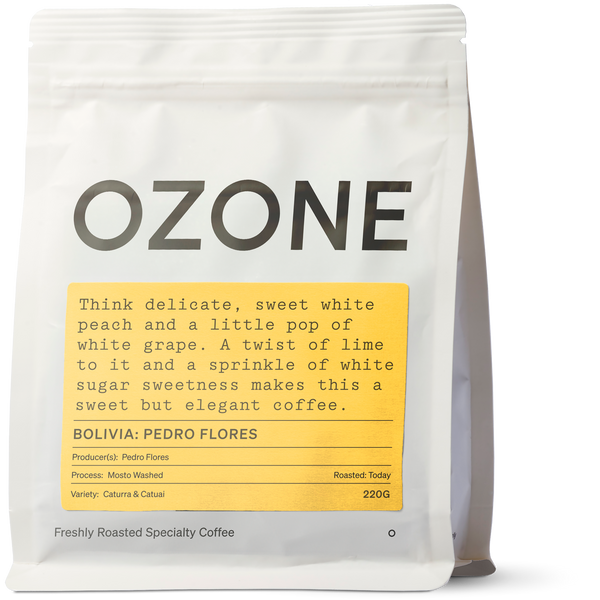
Gregorio Palli Mamani grows coffee on a hillside that was once rumoured to be sitting on gold. It isn't, as far as anyone can tell. But thirty-five years in, the land has turned out to be worth rather a lot anyway.
His farm, Volcán del Tigre, sits in Copacabana. That's a colonia, the Bolivian term for a small agricultural village, tucked into the hills of Caranavi province. Caranavi means "high place" in Aymara, and it's earned a second name since: the Coffee Capital of Bolivia. Around 13,000 hectares of coffee grow here. The town itself sits at 976 metres, too low to grow anything worth roasting, so the farms are scattered across the surrounding slopes, in a transitional strip of country where the eastern Andes tip down towards the Amazon basin. Lush, steep, and very good at making coffee.
The road to Caranavi
Gregorio's family didn't start here. He was born in Muñecas, a remote province just north of Lake Titicaca, in a town with no school. So his parents packed up and moved roughly 100km to Caranavi, purely so their son could get an education.
It's a decision that keeps paying off. Gregorio is a full-time coffee producer now, thirty-five years into the job, living on the farm with his wife Daisy and their two youngest children, who help out when they can. His brother Julio runs a nearby farm called San Bartolomé. And his daughter Nancy, one of two grown-up children from his first marriage, has graduated from playing on her dad's farm to running her own. We've been roasting Gregorio's coffee since 2019.
Smoke, gold and a tiger's path
Before it was a well-tended specialty farm, this land was wild. Locals swore they could see smoke drifting up from one of the jungle hills and decided it must be a volcano. Local legend has it that where smoke rises from the hills, there's gold to be found underneath.
Around the same time, people noticed a footpath worn through the undergrowth. Not a human one. It was a trail made by a jaguar, known locally as a tigre, doing its rounds.
Put the two together and you get Volcán del Tigre. Tiger's Volcano. No gold has surfaced, and nobody's seen the jaguar in years, but Gregorio still won't keep livestock on the farm. No sense tempting fate.
Two farms, facing each other
Volcán del Tigre runs to 12 hectares, though only two are currently planted with coffee. The other ten are the plan. Gregorio has been expanding his growing area steadily, and he has a clear idea of what the farm looks like in another ten years.
Nancy's farm sits just across the valley, on the opposite hillside, close enough that father and daughter can look across at each other's trees. Hers is smaller, and it doesn't have a name yet. In Bolivia that's normal for newer farms. Naming tends to come with size and time, and Nancy hasn't been at this as long as her dad. Roland, our Green Buyer, met the whole family there on his 2025 trip. On the strength of what's in the cup, we'd say a name is coming.
What Sol de la Mañana changed
Both farms are part of Sol de la Mañana, or "morning sun", Bolivia's first producer mentoring programme. The Rodríguez family of Agricafe set it up in 2014, after fifteen local farmers approached them for help.
It runs like a school. Seven years, start to finish, covering nursery management, planting, soil, pruning, selective harvesting, pest control and financial planning. Before the programme, most farms in the region were what the family politely call "wild". Visited at harvest, largely ignored the rest of the year, two to four bags per hectare. Many participating farms now manage 20 to 30. Producers also receive 70% of the price their coffee sells for, so the improvements land where they should. The SCA gave Agricafe and Fincas Los Rodríguez its 2019 Sustainability Award in the Business Model category, largely on the strength of the programme, which now supports more than 100 farms across the region.
The backdrop is worth knowing. Bolivian coffee exports fell from roughly 150,000 bags a year in the early 1990s to 22,000 by 2020, as leaf rust spread and farmers moved to other crops and other work.
For Gregorio, the practical wins have been about defending what he's got. He's had trouble with leaf rust, coffee borer beetle and ojo de gallo (American leaf spot, a fungus that thrives in exactly the cool, humid, high-altitude conditions that make Caranavi coffee taste so good, and strips the trees of their leaves). The programme taught him how to get all three under control. On two hectares, losing even a slice of the harvest to pests is the difference between a decent year and a difficult one. Nancy, newer to all this, is getting the same grounding from the start.
In the cup
Cherry from both farms goes down to Agricafe's Buena Vista mill in the evening. Every sack is weighed, sampled and logged before processing, along with the farm, the producer, the elevation and the varietal. Cupping results go back to the producer afterwards, which is how a farmer learns what worked.
Traditionally that's meant a straight washed process. More recently it's meant Mosto Fermented Washed, where the fermentation liquid from an earlier batch is used to kick-start the next one. Think of a sourdough starter, but for coffee. The current lot goes a step further again. It's anoxic washed, a method developed by Adrián at the Buena Vista wet mill: a low-pressure CO₂ flush strips the oxygen out of the tank from the start, and a yeast population isolated from a cherry on one of the Rodríguez farms drives the fermentation.
In his free time, Gregorio walks around town with his kids, swims in the river and plays football. Which, after thirty-five years of hillside farming, seems more than fair.
Details
- Country: Bolivia
- Department: La Paz
- Province: Caranavi
- Colonia: Copacabana
- Farm: Volcán del Tigre
- Farm size: 12 hectares, 2 planted with coffee
- Elevation: 1,400 to 1,650 m.a.s.l.
- Varietals grown: Caturra & Catuai
- Processing: Washed, Mosto Fermented Washed and Anoxic Washed
- Programme: Sol de la Mañana
- Buying relationship since: 2019
Gregorio and Nancy's neighbours in Copacabana include a few other Ozone favourites, Vincent Palli and Martin Chirino among them. Have a look at the rest of our Bolivian coffees if you'd like to explore the region further.